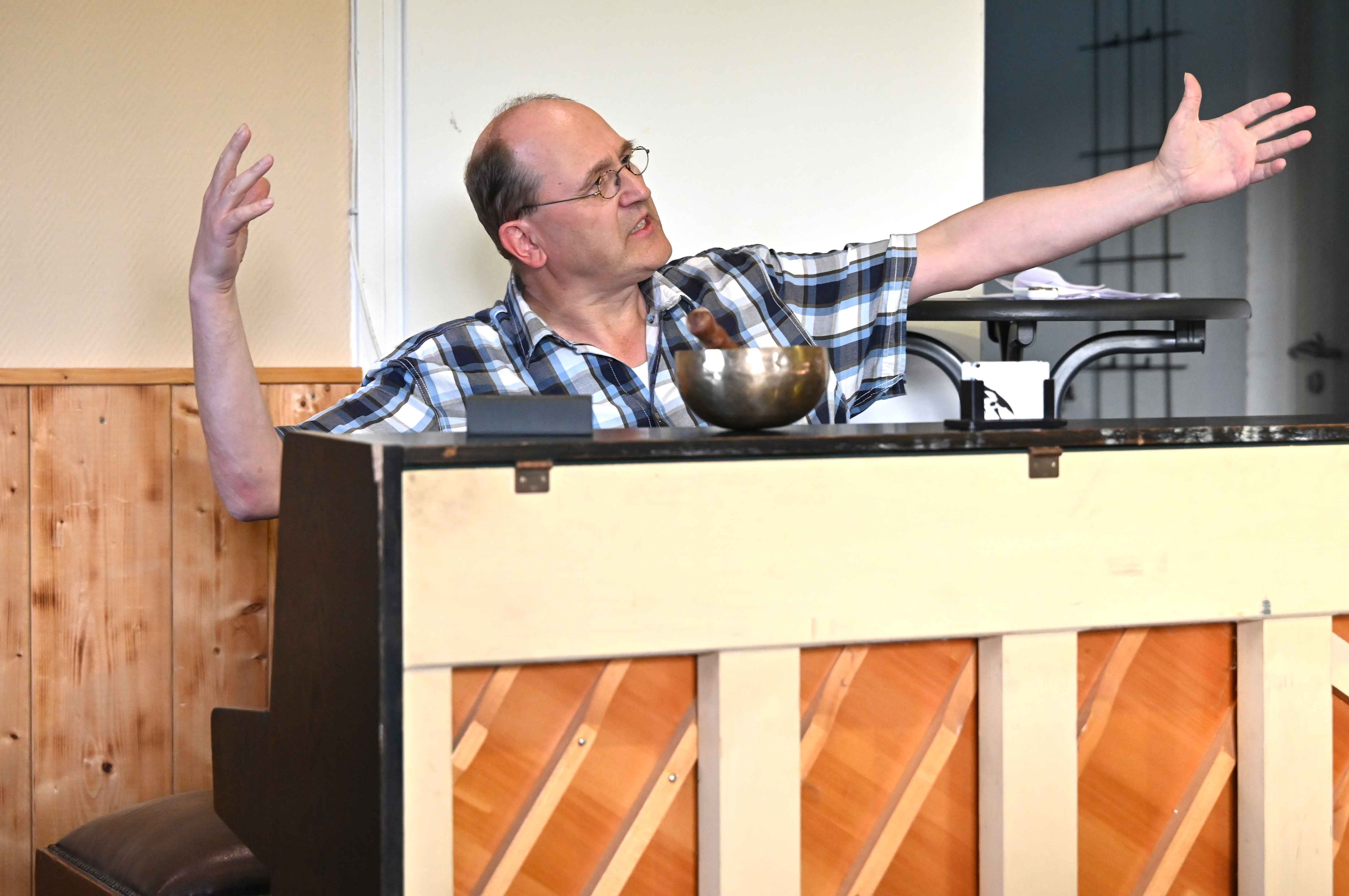
Folk Club # 157 in May 2025 – Hail, Hail The First Of May!
“Imagination” was the motto of Folk Club No. 157 on May 2,
2025. What a theme! Every contribution fits in with this, because the authors
of the songs and poems need a lot of this ability to conceive their works. In
addition, many of the texts require the listeners to use their imagination to
understand what is meant. Quite obviously (we should also take a closer look at
this word), imagination is the greatest asset that humans can have. No wonder
that this beautiful German word is at the top of our chief John Harrison's
popularity scale. Compared to their English equivalents, the German terms for
sensory perception come from our traditional, immediately comprehensible
vocabulary, while the English language relies almost exclusively on words of
Latin or French origin in this area. Unfortunately, writers are increasingly
tending to replace the mostly pictorial German words with Anglicisms, which may
sound fashionable but tend to obscure the nature of what is being described to
German-speaking readers.
But enough of these old-fashioned linguistic observations,
let's get on with life. John Harrison's introduction to the evening did
not require too much imagination. As he does almost every year at the May Folk
Club, he started with an a cappella song praising the merry month of May:
“Hail, Hail, The First Of May” is the title of the song, which sounds like an
old-fashioned folk song but is actually a composition by contemporary English
folk musician Dave Webber. The musician is said to have been very surprised
when, during the May singing in Padstow, he was accused of singing the
traditional Padstow song with the May song. Dave first had to enlighten the
assembled troupe about the true origin of the song. However, this incident was actually a great honour for Dave.
John's slightly altered song “Albert McTavish's Brand New
Frigidaire” was a good fit for the theme. In it, John tells the story of a man
who lives alone with his wife on a deserted island in northern Scotland. One
day, he is supposed to get a refrigerator because his wife likes to eat jellied
eels in aspic even in summer, which requires refrigeration. When he finally
manages to bring the appliance from Edinburgh, it turns out that he has bought
a gas-powered one instead of an electric one. His wife, who is very strong and
skilled with her hands, has built a wind turbine in the meantime. The story
then takes a tragic turn. Albert and the refrigerator have been resting at the
bottom of the sea ever since. The musical variation of the piece that follows
is purely instrumental, allowing the listener to let the story pass before
their mind's eye once again.
The song “Hard Times Come Again No More” by Stephen Collins
Foster actually dates back to the mid-19th century. Known as the father of
American music (composer of “Oh! Susanna,” “Swanee River,” and others), Foster
reminds the wealthy to take care of the less fortunate. The beautiful song
about the berry pickers in Blairgowrie, Scotland, “The Berry Fields Of Blair,”
appeals to the imagination of the listener. The song by Belle Stewart from 1947
describes summer berry picking in the aforementioned area in times gone by.
Workers from industrial areas earned some extra money there during the unpaid
company holidays of the time and had some fun besides work.
John then had some musical fun with Holger Riedel.
Holger, who is always good for some quirky performances, had slightly modified
Jimi Hendrix's song “Hey Joe” to “Hey John” (“what are you doing with your
thing in your hand”). To Holger's somewhat adventurous piano music and
woodcut-like singing, John skillfully improvised Hendrix-style guitar riffs, so
that the overall work made a thoroughly respectable impression and was
definitely a nice joke – the applause showed that the audience had enjoyed it.
Hans Ihnen then took the evening's theme very
seriously with Ozzy Osbourne's “Dreamer” and Karat's immortal “Über sieben
Brücken musst Du gehen” (You Have to Cross Seven Bridges) – both beautifully
played on the piano and sung, and rewarded with hearty applause.
Wolfgang Schriefer, who has since become the Folk
Club's resident poet, made up for a piece that was actually intended for the
Folk Club in April. Wolfgang was unable to attend last month. We remember: it
was about women's names. Wolfgang had written a hymn to his wife Brigitte and
composed various melodies for it. The
title was “Many Women, Many Names,” and I quickly recognised melodies from
songs such as “Nights in White Satin” by the Moody Blues and “Kathrin” by Bläck
Fööss. Ultimately, the most important message was: “Women have many names, but
there's only one you really want!” Wonderful, dear Wolfgang, your wife loves
you even more now.
John Harrison, who is also a resident poet at the
Folk Club, presented one of his odes to dandelions in keeping with the season:
“Dandelion II” is the title. The II indicates that it is not the only praise he
has penned. As beautiful as the poem is, your court reporter has a slightly
different view on the subject of dandelions – that of a gardener plagued by
stubborn weeds. It's like in real life: beauty is important, but it's not
everything.

Shay McVeigh, the featured artist of the evening,
comes from Northern Ireland and has been living in Endenich for years. In
addition to music, he also devotes himself to the visual arts. He brought along
some beautiful examples of his work and exhibited them. His selection of music
takes us again and again into the wide world of seemingly inexhaustible
compositions beyond the familiar. “Boston” by Irish singer-songwriter Mick
Flannery is probably only known to specialists. One wonders why something like
this isn't played on the radio. Or maybe I'm listening to the wrong stations.
Perhaps I'm too old-fashioned anyway: who still gets their music knowledge from
the radio these days? Shay beautifully adapted the song, which Mick Flannery
originally accompanied on the piano, for guitar accompaniment. The song “Agony”
by the English group Ezio also belongs in the category “should be played more
often.” Even when this group was mentioned, there was no sign of recognition
from the audience. After all, the group has already performed at the Harmonie
in Bonn in 2011. Yes, dear Shay, even if you seem surprised by this, the world
is too diverse for anyone to know and understand everything. But we have you to
discover songs. “Walk Away” by Tom Waits, on the other hand, is likely to be
better known. Shay may not have Tom Waits' hoarse voice, but his interpretation
is no less convincing. His fingerpicking is also top-notch. “Picasso” by
Citizen Cope is another contribution from the world of discovery, a touching
story about a homeless man who falls in love with the beautiful lady on the
poster near him: ‘The woman that I love, is forty feet tall’ is one line. In
the end, the homeless man successfully fights to prevent the poster beauty from
being removed. Your chronicler remembered this song because Shay had played it
several times at the Folk Club.

After the break, Andreas Kulik, now an
old acquaintance at the Folk Club, started the round. He loves the works of the
Polish group Stare Dobre Małżeństwo, which means “Good Old Marriage” in English
– what a bold name for a group! “Zawieja w Michigan” (Storm in Michigan) is the
title of the first song. The group is apparently a big deal in Poland, but here
it is only known among Polish immigrants. The song ‘Idz delej’ (Keep Walking)
is also by them, a touching ballad. ‘Autumn Leaves’ does not come from Andreas' Polish homeland. The melody, which is now considered a jazz standard, was
originally created by the French – “Les feuilles mortes” was the title of the
composition by Joseph Cosma based on a poem by Jacques Prévert. Johnny Mercer's
English translation made the song world-famous and immortal, and it was sung
and played very sensitively by Andreas Kulik at the Folk Club. Andreas
concluded with an original composition in German entitled “Menschheitsfamilie”
(Human Family) – a thoughtful work in a time full of inhumane and ruthless
conflicts – much applause for Andreas and his pieces, which are well worth
listening to.
Is there a new star in the Folk Club sky? It could be, and
it would even be a triumvirate. Iris Brück, Carsten Exner, and Steffi
Sawatzki are the three who know each other from their work in their
association “Motiviva” for children, youth, and family assistance.
Somewhat shyly, they started their performance with the
well-known song by Hal David and Burt Bacharach, “Raindrops Keep Falling On My
Head.” It quickly became apparent that shyness was completely misplaced.
Carsten played a confident accompaniment on his guitar with beautiful
fingerpicking, and the women's voices were strong in volume, confident in
intonation, and complemented each other wonderfully in two-part harmony. And
then the three had to announce a song that had already been played by Andreas Kulik.
“Autumn Leaves” was
now performed by a trio. Surprises are the spice of life at the Folk Club –
there are usually no agreements, so occasionally there are duplicates. The
audience was allowed to decide for themselves which version they liked better.
For their third piece, the trio chose “Venus” by the Dutch group Shocking Blue.
Your chronicler still vividly remembers his school days. Back then, we also had
pop music in music class, which was super modern. Our progressive music teacher
had studied as a clarinetist in the US and had a keen sense for newer sounds.
The class was allowed to choose a piece, and the choice fell on “Venus.” I
remember that the teacher praised the intro highly, but dismissed the lyrics –
which were very modern for the time – as rather misogynistic: the woman who
only gains importance because of her physical charms. In addition, the singer
Mariska Veres made a glaring mistake in the lyrics at the time, and that in the
official record version: she sang “Godness” instead of the correct “Goddess.”
Our music teacher also taught English, so he couldn't resist making a comment.
However, the criticism did not detract from the song's popularity, then or now.
Carsten, Iris, and Steffi were wonderful in all three songs, and we hope they
will grace the Folk Club with their presence again soon.

Peter Bachmann, who can draw on his huge repertoire,
has become almost part of the Folk Club's inventory. This includes many songs
in German. “Einfach sein” by Willy Astor is a really good song that gets under
your skin and should inspire our imagination. Peter wrote his own lyrics in his
native Rhineland dialect for Steve Harley's song “A Friend for Life” – “Vür et
Levve en Fründ” – a beautiful variation and true folk! Bravo Peter and much
applause.
After so many highlights, our featured artist Shay
McVeigh returned to the stage in the second half of the evening and
introduced us to the world of lesser-known songs:

Country lovers, however, will be familiar with the wonderful
country ballad “I Dream Of Highways” by Hoyt Axton. Shay's version was
considerably less schmaltzy, making it a really good interpretation of the road
ballad. Damien Rice, an Irish musician, wrote the song “Lonely Soldier,” which
is not schmaltzy at all. Years ago, the song's author himself failed to provide
an answer as to its meaning. Interpretations range from a call to end the war
to a longing for death. Either way, the lyrics are rather disturbing. In a film
series about a dubious motorcycle club in California (Sons Of Anarchy), the
song “Wish It Was True” by a musician named “The White Buffalo,” alias Jacob
Aaron Smith, was used. The song is a desperate cry for sincerity, which the
singer sorely misses in the world around him—very impressively interpreted by
Shay. Another problematic world is described in the song “Carmelita” by Fred
Eaglesmith. It is about migrant workers and their hardships. Shay followed up
his impressive performance with the song “Dust” by the Dead Tongues. It is a
love song and quite melancholic because the love remains unfulfilled. But it is
precisely the melancholic songs that appeal to us most, isn't it? Lots of
applause for Shay for his song selection and captivating interpretations.
Of course, the evening couldn't end without the community
paying tribute to Jock Stewart, the patron of the Folk Club.
See you on June 6 for the 158th edition of the Folk Club.
The motto is “Sunshine, Light, and Colours.” Well, it should be possible to
find musical contributors for that.