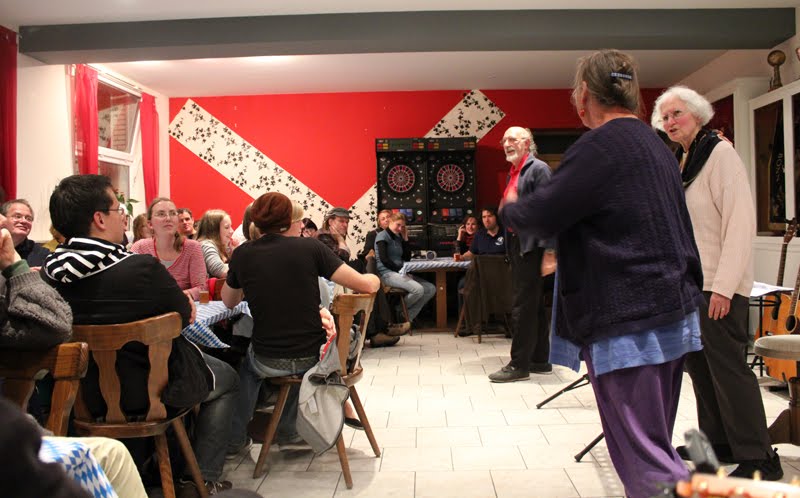
The October folk club was almost standing room only before the first note resonated, which unusually this month came from Barry’s piano, as we decided at the last minute to simply switch the sets around due to some of the earlier scheduled floor spots being caught in traffic.
With the Beatles classic “With a little help from my friends” as an opener
Barry not only managed to get everybody singing along but proved with the hard hammering chord crescendo at the end that his “dicky elbow” is now indeed well healed. Collin Raye’s country tear jerker “If You Get There Before I Do” followed and showed that not only the Blues can make your eyes water. In fact if you click under “Internet Radio Links” on the right hand side of the Folk Club Bonn blog you’ll find shedloads of good Country, Blues and even Folk music to keep you going until the next folk club meet. Barry continued in melancholy mood with Brad Paisley’s “Whiskey Lullaby” a love song about an estranged couple who finally, one after the other, put a “bottle to their heads and pulled the trigger” enabling the angels to sing a whiskey lullaby.
Welcome back with a vengeance Barry!
We have always maintained that the folk club is not there just for music and song but that we are also open for poetry, dance, recitals, sketches and drama if anyone feels the need. During the second spot of the evening
Raid Sabbah, a Palestinian writer born in Germany, didn’t dance, didn’t sing or play any instrument but in one way or another ticked all of the other boxes in a most unusual and enthralling way. He described from a story he had written in his youth about the tortured history of the holy land in the Gaza strip, told not through his own eyes, but through the eyes of a stone. Now we all know that stones have no eyes or thoughts or feelings, ... or do we ?
Raid’s piece was certainly a very vivid reminder of how, in some respects, humanity has really not progressed all that far since the stone age.
The first guitar of the evening was wielded adroitly by
Daniel Mennicken who now runs the OpenMic live music sessions for performing songwriters in Bonn on the second Saturday of each month. His accomplished finger picking guitar work is a joy to hear on its own, but when embellished with his lilting vocals it moves on to a higher plane. His first song ”Maggie” from Colin Hay a Scots Australian about lost love was followed by James Taylor’s “Mill Worker”. His final song was an outing of his love shared with Barry of good country music with the story of a “rambling man” not by Laura Marling, or the Allman Brothers, or even Ewan MacColl, but the song “Colder Weather” by Zac Brown from Atlanta, Georgia who plays a deliciously modern fusion of country music, southern rock, and folk.
Listening to all of the various artists this evening reminds one of what a folk club is really all about, well described if you listen to the “Featured Video” halfway down this page here :
“Where Music Matters”
(Just press “click to play”)
http://www.bbc.co.uk/programmes/b007c0h6You will hear, and indeed see, the DJ and musician in his own right, Colum Sands, who hosts the Saturday night radio programme on BBC Radio Ulster which goes out between 20:00 – 22:00 hours each week, (and which coincidentally is also called “Folk Club”) explaining a little pearl of eternal wisdom.
“When you head out with a guitar and a few songs, you’re not going out to teach, you’re going out to learn”.Astonishingly, thankfully and without exception, the guitarists and indeed all of the musicians, who come to the monthly folk club in Bonn somehow share this same benign musical mindset.
So by the time our special guests for the evening, the acoustic trio
“Joker” were half way through their first song and Renate began singing in a Zulu dialect from southern Africa, we were a little unsure if we were on the third, or already on the fourth continent, of the evening. Upon reflection it was indeed the fourth continent already.
“Joker” are an unusual group of talented acoustic musicians who did not seek one another, but simply, found themselves. Well that they did. A most enjoyable set followed with the “Push up of love” as
Silke Frost, who had a warm voice befitting her first name but certainly not her surname, joined “Joker” on back up vocals.
Renate Dohm writes most of the songs that Joker play and they are certainly pleasant enough on the first hearing, but evolve into veritable addictive ear worms upon subsequent and consequent hearings. She was born in South West Africa, today’s Namibia, and one can hear her early childhood bonds as she dedicates, not only a song to her “Grandpa”, but also perhaps involuntarily to the very heart and soul of Africa and afterwards to the rest of the known world. The most amazing continent of all where all those generations hence the earliest humans, simply got up and went. “Night Animal” conjures up visages of nocturnal animals both wild and more domesticated on the plains of Africa and astral turf. “Trip to Greece” also started off gently and developed into the upbeat jazz scat which is one of Renate’s vocal trade marks. It is this underlying element of jazz exuding to different degrees from all of “Jokers’” cast which when combined with the originality of Renate’s song writing which make them what they are.
The break is, as usual, invariably too short, as there is already so much to muse upon, and so little time in which to reflect and connect. (Thinking that Detlef might take a fence or a hedge or a wall if we don’t put a football analogy in here somewhere: “networking” is what very good goal scoring centre forwards used to do to inadequate goalkeepers by keeping them in work by fetching their well placed scoring balls from the back of their respective nets.
--------------------------------------------
A loud re-awakening (brought "to" or "upon" us by Master
John) is often as not the best remedy, as we then slip from North America in 1930 with the Mississippi Sheiks and then to Australia in 1895 as one of the early German immigrant sheep shearers “auf der Walz” tried to separate the sheep from the wool, or the wool from the sheep, whichever the case may be, before he danced and sprung into the ghostly legend of an old ox-bow lake, and afterwards taking a fictional lady for a last Vienna Walzer.
It’s Australia’s unofficial national anthem, “Waltzing Matilda”.
For that old jolly “swagman” messing with that old jolly Jumbuck, it really was, “The last fair deal gone down”, the very last dive deep down into the old Billabong near Winton in Queensland. From whence his ghost still sings, “who’ll come a Waltzting Matilda with me?”
Detlef Martin from “Joker” is also a very jolly guy and after spontaneously sitting in on a Duke Ellington number in July, took up once more from
John not just the challenge but the brushes to paint a rhythmical accompaniment worthy of any painter’s pallet to Robert Johnson’s classic song about musical dives and “Juke Joints” in Louisiana.
Next up after the break were our old friends the
“Proud Merries” this time under the solid musical direction of the competent
Peter Philips – no timing issues here - on guitar and harp simultaneously – who say only felines are capable of multi-tasking?
Very well done as they led us through “Have you ever seen the rain”, “Unchain your heart”, “Wonderful tonight”, and finally the Johnny Cash classic “Ring of fire”. Tunes so catchy even the bar staff were hip-swinging in unison!
(Compliments to Jupp! Only when you’re so quiet back there with the background noise at the bar, can this possibly happen!- gut gemacht Jupp!)
The next people up were what a folk club really is about - a world wide web of walk-ins by people who long ago discovered the unity of humanity immersed in a network of folk clubs around the world. No two are exactly the same but a common unwritten “law” connects them all in their willingness to make strangers welcome. Much to the chagrin, we fear sometimes, of our very own regular diligent floor spots, without whom we could not exist so well or even at all, but we always have, and always will, hold a floor spot open for a stranger, someone who has often travelled from a long distance, or a friend of a local who lives a long way away. Someone who didn’t play or sing last time, and could not possibly sing or play next month, someone who for whatever reason, cannot formally apply to do a floor spot next month as a local resident would usually do.
A certain
Hanny Budnick, an effervescently bubbly lady, approached us early in the evening and wished to say something, as well she may.
“Is the audience at the Folk Club bilingual?” she asked,
“probably as good as it gets?” we reply humbly.
This lady from Philadelphia comes from the USA with the audacity to wish to say something and sing something and she may, this is a folk club after all, and she does indeed recite a poem in German from Rainer Maria Rilke, which is so very passing for the season, an Autumn day,
Herbsttag
von Rainer Maria RilkeHerr: es ist Zeit. Der Sommer war sehr groß.
Leg deinen Schatten auf die Sonnenuhren,
und auf den Fluren laß die Winde los.
Befiel den letzten Früchten voll zu sein;
gib ihnen noch zwei südlichere Tage,
dränge sie zur Vollendung hin und jage
die letzte Süße in den schweren Wein.
Wer jetzt kein Haus hat, baut sich keines mehr.
Wer jetzt allein ist, wird es lange bleiben,
wird wachen, lesen, lange Briefe schreiben
und wird in den Alleen hin und her
unruhig wandern, wenn die Blätter treiben.
Which was enjoyed by all the audience, but in case anyone was, or is, struggling with the German, this translation is by Guntram Deichsel:
Autumn Day
by Rainer Maria RilkeLord, it is time. Let the great summer go,
Lay your long shadows on the sundials,
And over harvest piles let the winds blow.
Command the last fruits to be ripe;
Grant them some other southern hour,
Urge them to completion, and with power
Drive final sweetness to the heavy grape.
Who's homeless now, will for long stay alone.
No home will build his weary hands,
He'll wake, read, write letters long to friends
And will the alleys up and down
Walk restlessly, when falling leaves dance.
Translation to English: (C) Guntram Deichsel
That was joy enough :-), but not sufficient for this tenacious lady, Hanny who is active in the folk and folk dance scene in Philidelphia led the audience in a Konon/Round in English in three parts, not alone, but ably accompanied by
Ray Tackett and
Karin Hlavace in the rounds, each taking one of the lines:
“The chickens are into the To-ma-toes”
“And even the rabbits inhibit their habits when carrots are green,”
“Squash, Squash”Strange :-() somewhat bizarre words, but wonderful nevertheless! As so often in life, it is the unexpected simple pleasures which are the most memorable.
Next up was our trusty stalwart from Düsseldorf,
Thomas Steffens who normaly makes the journey to Bonn in well under an hour, but today was of those “caught in traffic“ with a journey of over one and a half hours before he finally made it to the folk club.
For people who think or simply moan, is a journey to the far most northerly province of Bonn in Graurheindorf, even further north than the Roman encampment and harbour in Bonn worth the journey just for a bit of unplugged music?
Thomas seems to think so, and we’ve set him up extra in a call centre right in the middle of Dehli to field your calls about,
“Wie weit darf ich fahren bis ins Folk Club zu landen?”.
Due to the terror that war can cause we will have to vet your applications to call him, but extra terrestrials may still apply.
Thomas is a very firm favourite amongst our regular folk club scribes and we can, in review, see why, renown not only for his driving 12 string rhythm guitar and forceful vocal delivery, but also for his excellent choice of core folk club material, which invariably leads one to be side tracked on the musical internet highway which is You Tube for hours on end. The first song from Thomas continues in the Autumn vein started by Hanny with a song by the London born singer songwriter Colin Wilkie entitled “Autumn is knocking at our door my love”. The reason Colin seems to be more popular and better known in Germany rather than old Blighty from whence he hails is probably attributable to the fact that he emigrated to Germany in the 1960s and still lives here. Thomas continued with the song “Ellan Vannin” which is not only the Manx-Gaelic name for the Isle of Man which houses the Tynwald, the oldest parliament in continuous existence in the world dating back to Norse Viking times, and is situated in the Irish Sea, but also the name of a mail boat the S.S. Ellan Vannin which went down with all 21 hands and numerous passengers in a storm on its way to Liverpool over a hundred years ago. Ellan Vannin was written by Hugh Jones of the Spinners and slips well into the folk club tradition of remembering not to forget. Thomas’s third song was the “Port of Amsterdam” initially written in French by Jacques Brel, the famous modern Chanson writer and singer, and initially made popular in English by none other than David Bowie. A song based in the harbour about a sailor whose diet consists of only fish heads and tails
http://www.youtube.com/watch?v=ycsmdjhfJmw&feature=related and finally dies of too many dreams and too much drink. So Thomas is a fine performer and a good guitar picker as well as an astute picker of songs and not only that but he graciously yields some of his initially allotted set in order for us to make the necessary extra space for the walk-ins.
Thanks for that Thomas...
Time was indeed fast running out as
“Joker” were finally able to take the stage for their final set of the evening. “Joker”, two very tastefully played acoustic guitars and still the first “non marchable” drummer ever in the folk club, looked at first glance as if it could, should or might, not possibly work. However, motivated by Renate Dohm’s “feet in the core of the earth” songs and confident intonational vocals, empowered by her deservedly great sense of conviction in her own song writing, fellow guitarist
Arno Fleckenstein and percussionist extraordinaire
Detlef Martin move and dance around the thus induced musical imagery with a dexterity more akin to soulful jazz musicians than mere folk ones.
This was never so pertinent as in the opening song of their second set. Living on the south west edge of a vast continent with the whole of Africa as your hinterland then “The Ocean” was a logical song for Renate to look to next. With Detlef’s cymbal work and Arno’s slide guitar the scene was set so well that not even a boat was necessary to be there. Moving straight from the sea to the air “Bumblebee” once more draws on the intense imagery which is so much intertwined with the verbal tradition of African peoples. No matter how materially “poor” they may be by western monetary standards, we will never aspire to be anywhere near as “rich” as they are linguistically and expressively. “Bumblebee” is a lullaby for a child but alludes, in this old tradition, not just to the bee but also to bombs falling from the skies overhead in 1944, reminding us that there is sometimes, in such situations, just “no time to cry”. Soon Detlef’s solo bongos pilot us “after a Caribbean day” into “Pelican Bay” and we are all temporarily transformed to a place which is very far from Graurheindorf.
Silke Frost's role in extending the trio into a quartet for most of this evening was an additional unexpected enhancement.
If the folk club in Bonn has done something, it has hopefully brought “Joker” to a wider audience, who can appreciate their musical skills and also introduced them to Renate Dohm’s remarkable songwriting talent.
Most people left the room into the dark night, relishing the fact that they had heard an awful lot of good live music and picked up a lot of well selected vibes from five, rather than the mere four initially promised continents of the earth on this Friday evening in the northern suburb of a small town in Germany, and from four rather than three members of “Joker” were the special guests.
Dizzily briefly “sitting on top of the world” admiring and visiting five of its continents and many more of its cultures, yet leaving a much smaller carbon footprint than the average squirrel. Truth is, it was only the “tip of their own musical iceberg” which each person warmly packed into their very own “Tuckerbag” and took home with them after the folk club.
No challenges from the squatter, or the three troopers homeward bound on the Estermannstrasse, es ist keine richtige Einbahnstrasse.
Mission accomplished once again.
And a very big sincere thanks to all participants, active, passive, vegetable, animal or mineral or as Keith Richards of the Rolling Stones would have said after saying to a journalist, “Michael Jackson dying before me- you didn’t see that one coming now did you?" grins
and after listening to Raid Sabbah ....
“perhaps let’s not get so “stoned” again?”